


We're FUNDED!!!
We are 100% funded! Truths We Tell: Stories From The Yarn Stage will be going to print and will be widely available in fall 2021.
We are so inspired by the generous support and reception for this book that we want to host something special. If we raise $2k more, for a total of $9k, we will host an outdoor book launch party, featuring live readings from the storytellers featured in the book.
We are absolutely ELATED and so thankful to each of you who have shared your belief in the power of storytelling! With less than 48 hours to go, we look forward to pushing with you to reach this stretch goal.
STAY TUNED!
Who's in The Book? Storyteller Reveal from Truths We Tell: Stories From The Yarn Stage
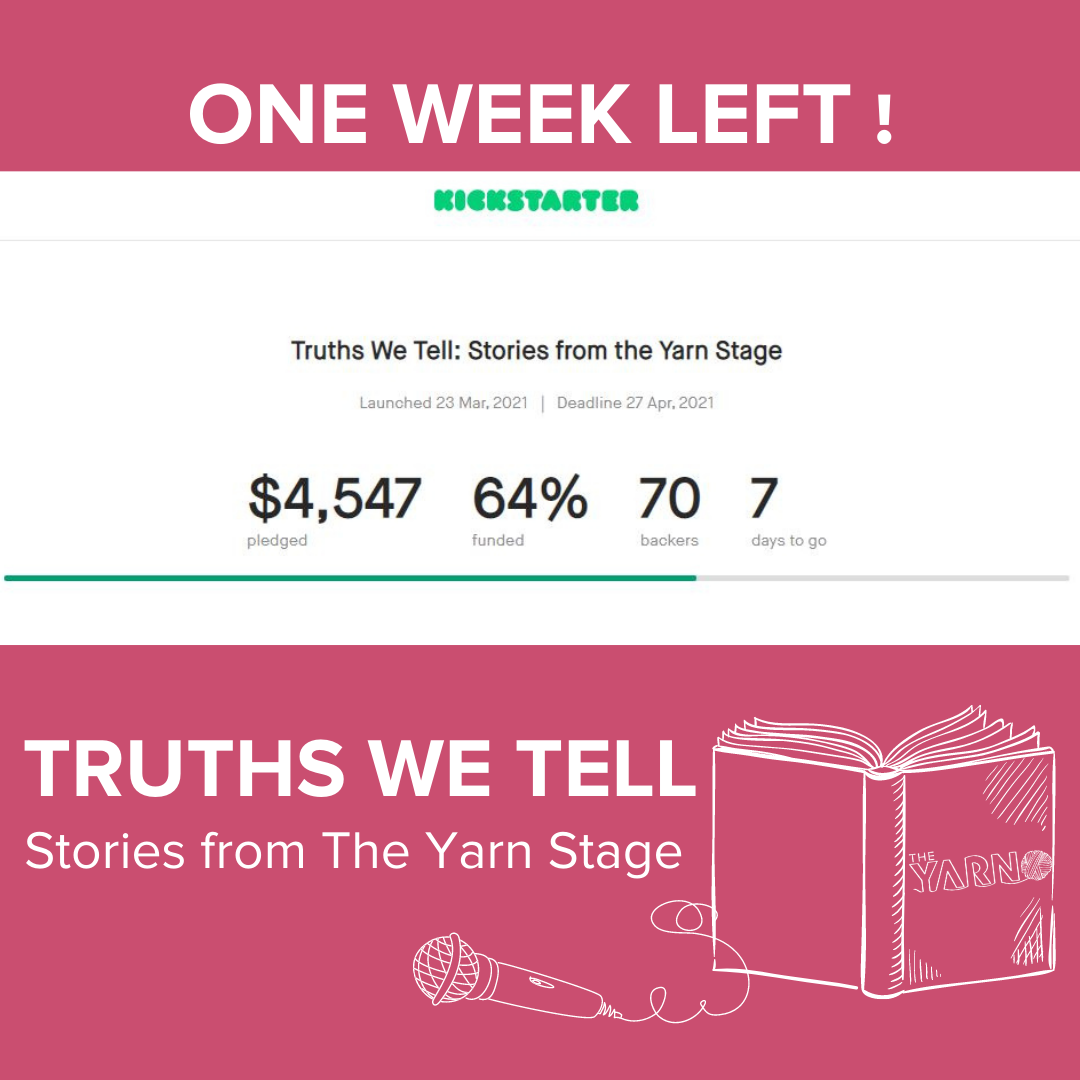
We’ve got one week left to raise the last 36% of our goal! We are so thankful to the 70 backers who have helped us reach 64% / $4,547, and it’s all in during these last 7 days so we can bring the power of storytelling to print.
This last week, we’ve got exciting things in store . . .
All week long, we will be revealing the storytellers featured in Truths We Tell: Stories From The Yarn Stage and sharing hints about their stories that reveal the range and richness of narratives you can expect in the book.


Stay tuned for more storyteller reveals throughout the coming week . . .
New Contract: Invitation to Intimacy by Judy Tiesel-Jensen

Et Alia is so pleased to welcome the first therapist author to the Et Alia family! Judy Tiesel-Jensen’s memoir, Invitation to Intimacy, is forthcoming in late fall/early winter 2021.
Through the innermost workings of the 35-year relationship between two marriage therapists, you’re invited to reconsider the meaning and power of intimacy.
ABOUT INVITATION TO INTIMACY:
Much more than “just sex,” true intimacy flows from often-inadvertent invitations to be deeply known to another, and both the spontaneous and soul-searching decisions about whether to accept the invitations we’re offered. Perhaps our strongest emotional desire is to feel understood, received, and loved in our closest relationships. Yet to be known and to know another deeply, especially in the context of marriage, we risk pain, loneliness, and betrayal. Is intimacy worth the risk?
This candid memoir begins with a husband’s dramatic diagnosis and weaves marital flashbacks and counseling sessions into the progression of his disease. Despite their degrees, licenses, and the specialized knowledge they shared daily with their own clients, they faced the same challenges as everyone in lasting relationship. What would sustain them through the darkest nights of their marriage?
Through the everyday decisions and extraordinary movements that compose one marriage between two therapists, we see what is possible for every couple—the exhilarating, frightening, and ultimately healing power to accept invitations to intimacy in our lives.
ABOUT JUDY:
Judy Tiesel-Jensen pursued a Ph.D. in Marriage and Family Therapy to fulfill her long-held interest in couple relationships. From early in her first marriage, she and her late husband – also a licensed counselor – led parenting workshops, marriage enrichment retreats, and eventually saw couples together in counseling. She is a Licensed Marriage & Family Therapist and Psychologist Emeritus, and holds professional memberships in American Association of Marriage & Family Therapists (AAMFT), and EMDRIA (Eye Movement Desensitization & Reprocessing International Association). She was also among the first to get advanced training in Discernment Counseling.
Judy has been a therapist for over thirty years; Her private practice of over twenty years in the Minneapolis-St. Paul area specialized in couple/marriage therapy and trauma.
She taught marriage and family therapy students for over twenty years, was lead researcher for the Minnesota Family Strengths Project, and has served on boards locally and nationally for family organizations. She received the Distinguished Service Award from the Minnesota Marriage & Family Therapy Association. She has published in the family area, spoken at local and national conferences, and has been a resource for media inquiries regarding couple relationships.
Judy now is creatively retired and lives in Arkansas with her husband, Peter, with whom she offers consultations. Together they have eight children and fifteen grandchildren. She enjoys life on the river and watching pelicans from her writing desk.
Growing Up (all through life) . . .
As a child, Judy (Watson) grew up in funeral homes. Whether she wanted to or not, she learned about death, loss, grief, and the healing comfort given by caring professionals.
As a young wife, Judy (Tiesel) grew up into further as the the designated “pastor’s wife” in several congregations. Whether she wanted to or not, she learned about the deeply charged emotionsnal—and often unresolved—dynamics that members invested in their congregation and clergy family. She discovered church families—like all family relationships—had potential to hurt and heal.
As a young professional, “Dr.” Judy (Watson Tiesel) had more growing up to do as she finished her doctorate, taught therapy students, and developed a clinical practice while juggling the demands of three kids. Her source of strength, encouragement, and honest challenges through this phase was her husband, Reuel (“Rhoo-el”). wanted to convert her personal and professional understandings into ways of bringing insight and healing to clients. Because her own marriage so galvanized her growth, she knew the potential of close relationships to both inflict the deepest pain and provide the most profound healing.
As a new widow, Judy suffered the other side of grief from what she had witnessed as a child, pastor’s wife, and therapist. She was on the receiving end of loving expressions of care, which eased tThe all-consuming pain of loss. was abated by the expressions of love and care. A seed began to grow was planted that the story of her marriage might inspire, challenge and stir others to greater intimacy.
As a new wife in a second marriage, Judy (Tiesel-Jensen) accepted another, different invitation to intimacy, discovering new crevices and clefts in herself as she ventureds into a new relationship. Whether she wanted to or not, she discovered, happily, that she was not done growing up.

Image by Lyndsey Sullivan
RealSimple Magazine Features Sarah Catherine Gutierrez (aka Ladysplaining Money)
Heading to mailboxes nationwide in print and online in the April issue of Real Simple Magazine is an article about retirement featuring Sarah-Catherine Gutierrez (aka Ladysplaining Money), author of But First, Save 10: The One Simple Money Move That Will Change Your Life.
“How to Stay Focused on Saving for Retirement, No Matter Your Current Financial Situation” by Kara Cutruzzula, author of Do It For Yourself: A Motivational Journal, says that it’s possible to feel good about retirement, whether you have a nice nest egg or not even a fledgling fund.
As Gutierrez tries to hammer home in But First, Save 10 and reiterates in this article, “automation is key.” Relying on behavioral science, Gutierrez says that we can get a leg up on our wily brains by setting savings amounts to automatically transfer so that our retirement builds while we go about our daily lives thinking about other things. Meanwhile, our savings are compounding, and when we are ready to retire, we can have the freedom to do so. Many may find that they don’t miss the 10% (or more) they dedicate to retirement if they commit to it early enough, and that it can be the ticket to financial freedom that allows them to leave an unhappy work situation, start a new business, or retire on their own terms.
In the article, you’ll also glean expertise from says certified financial planner Barbara Ginty, host of the podcast Future Rich, and Gina Zakaria, founder of Saving Whiz, a financial education platform.

Megan Volpert Nominated for Georgia Author of the Year
Megan Volpert, author of Closet Cases: Queers on What We Wear, has been nominated for the Georgia Author of the Year awards in the “specialty” category! We look forward to the winners list with fingers crossed!
Megan was nominated and won in 2020 for her essay collection, Boss Broad.


Thank You to our Kickstarter Backers for From Cotton to Silk: The Magic of Black Hair
Our Kickstarter Backers Gave Sew Much

30 Days
Goal: $7,350 / ACTUAL: $9,528
175 Backers
Regarding this outpouring of support, Crystal C. Mercer says, “Every fiber of my being is woven in thanks to all of the people that became a part of a tapestry of supportive love. From Cotton To Silk: the Magic of Black Hair is a dream come true, primarily because you all believed this was an important story to tell. And here we are, telling melaninated babies everywhere that they are beautiful in their natural state. I am so grateful.”
A special thank you goes out to Erica Swallow and Brett Wood, who supported the project at the highest level of $500 or more.
Please help us celebrate these generous backers:
Nichole Acosta
Kelli Russell Agodon
Scott Allen
Isabel Anthony
Michel Arnold
Denise W. Barreto
Shannon Blue
Lindsey and Crystal Boerner
Amy Bradley-Hole
Clint Brockway
Marie Butcher
Amy Carpenter
Melanie Castellano
Denise Chai
Medeleine Chaisson
Tabby Clancy
Tara Cole
Trigaila Cole
K. Coleman
Krystal Kaye Cornelius
Jo Cruz
Ashley Daniels
Derrick and Cara
Amber Dionne
Julianne Dunn
Bukola Ekundayo
Audrey Evans
Hannah M. Evans
Johnny F. Evans
Sydney Lartigue Fameni
Steph FH
Kathleen Fluegel (Auntie Kathleen)
Amber Fonner
Jana Forkel
Laura Frankenstein
Stewart Fuell
Meg Gholson
Jess Gisler
Kimberley H.
Jensyn Hallett
Gin Hartnett
Tanya Hollifield
Adele Holmes
Wendy Holmes
Devon K.
K8
Jen Karetnick
Janis F. Kearney
Danica King
Anna Kimmell
Holly Kinnamont
Marjorie Lacy
Laura
Learning Instigator & Love Activist
Oriana Leckert
Julius K. Lindsay
Emily Loker
Omar McFarlane
Kerri Michael
Mac and Ashley Murphy
Andrea L Neal
Rhonda Owen
Paloma
Ashley Papineau
Jessie Parker
K. Parker
Alexandra E. Payne
Mary Pamela Perez
Petra Philana
Michon J. Pittman
Nicole Pitts in Detroit, Michigan
Heather E. Pristash
Jamila M. A. H. Robinson
The Rodgers Family
Jamila Rowser
SJ
Martin E. Stein and Scott A. Saxon
Jaquay Smalls
Rebecca Lynn Gaylor Snyder
Shan L. Spyker
Kristal Rose Stockman
Melissa Struthers
Erica Swallow
Shawn Sweeney
Sara Swisher
Ivanna Terrell
Benjamin G. Thompson
Luis Torres
Trust Tree
Hilary J. Trudell
Joyce Turley
Stephanie Vanderslice
Shan Ware
Liyah Wasson
Shanika Whitehurst
Tyler Williams
Brett Wood
Yvonne, Curly Girl

Stuff Rye Is Teaching Me


You don't need me to tell you #internsrock! This small press for big voices leans heavily on interns and they teach me SO much. What sense does it make to keep all this knowledge in house? None! SO, here I’ll share some morsels from Et Alia’s spring 2021 intern Rye Hazlett. This post will be updated periodically.
Do You Have Permission or Are You Pirating?
Creative Commons Images
Lots of people post images they don't have permissions for. (Copyright of photographs, for example, belong to the photographer.) This theft of intellectual property is not only unethical, but illegal. Many use images they don’t have permission for unknowingly. Who wants to steal the creative stuff that doesn't belong to them?
Here’s what Rye taught me: You can do an "advanced search" on Google images to make sure the images you see are in the creative commons or can be licensed!
Since we just celebrated MLK Day and many people were using images of the great leader himself, I’ll use a search for MLK images as an example.
Go to google.com and click on the “Images” tab. Type in a search for the image you wish to use.
To the right of the Images tab, you’ll see “Settings.” Click it for a drop down menu and go to “Advanced Search.”

3. When you are on the “Advanced Search” page, scroll to the bottom until you see “Usage Rights” as in the screen shot below. Choose the desired rights for the images you want, and VOILA! You’re in the clear to use what you find for your project or to discover how you can license them (i.e. pay the copyright owner for your commercial use of them, if applicable.)


BetterInvesting Magazine Calls But First, Save 10 "A Perfect 10"!
Angele McQuade of BetterInvesting Magazine calls But First, Save 10: The One Simple Money Move That Will Change Your Life by Sarah-Catherine Gutierrez (aka Ladysplaining Money) “A Perfect 10,” going on to say “If 2020 hasn’t made the importance of saving clear enough, this book will lead you the rest of the way.”

Do I need a Copyright for my Book?
I am sometimes asked, “Do I need a copyright for my book?” Although before running Et Alia, I practiced law, this is not legal advice—it’s only intended to give a beginning glimpse and to try to help you from falling into trouble with spammy sites.
By virtue of writing your manuscript and saving it on your computer, and certainly by going through the layout and publishing processes, you have established a copyright in your work. So, you can feel free to write your first and last name and the current year, and don the copyright symbol on the copyright page to declare it yours. (Note, to make the copyright symbol in Word, use an open paren, the letter c, and a closed paren. When you space it should create the symbol (c)).
This act alone lends your manuscript or book many protections.
However, taking the extra step to register your copyright is a smart idea. It lends extra protections and allows recovery for attorney’s fees and statutory damages in the case of infringement (versus just recovery of actual damages if it is not registered). So often, if attorney’s fees can’t be recovered, it becomes “just not worth it,” to pursue a case even though technically you are totally right and whomever has pirated your intellectual property is totally wrong.
It’s only about $50 to register and it makes good business sense at that price to get all the protections you can for your work.
There are a LOT of spammy businesses out there trying to get you to pay them to do it for you, but you can always look at uspto.gov and copyright.gov for trustworthy information.
Start here to learn copyright basics and what extra protections registration allows: https://www.uspto.gov/ip-policy/copyright-policy/copyright-basics
Then you can look here to learn how to register: https://www.copyright.gov/

Announcing The Yarn Storytelling Anthology, forthcoming Fall 2021!
Announcing The Yarn Storytelling Anthology, forthcoming Fall 2021!
The Yarn Storytelling Anthology will continue The Yarn’s mission to amplify voices, build understanding, and create space for human connection. Through a combination of stories and poems, thirty contributors representing twenty live and virtual shows share their truths about love, adoption, family, coming out, the criminal justice system, failure, work, mental health, and love. Through their narratives, we hope that you will find points of connection or the ability to experience life through a different lens.
Et Alia is thrilled to partner with The Yarn to bring its storytellers’ voices from the mic to the page, committing to our shared beliefs in the power of narrative to challenge our own misperceptions, strengthen community, and spotlight nuanced Southern identities.
Stay tuned for more!

The Yarn’s founder, Hilary Trudell, signing publishing contract for The Yarn Storytelling Anthology

But First, Save 10 Now Available in Ebook!
As the new year approaches, we hope you’re busy setting your vision boards and laying plans to empower yourself in the coming year. Without saving for the future so that you are prepared to make necessary moves toward your personal goals, is whatever you hope to achieve possible? Ladysplaining Money and loads of financial experts would say good luck.
In good news, you can do this by yourself but you don’t have to do it alone! Now you can read But First, Save 10: The One Simple Money Move That Will Change Your Life in paperback or in ebook format. You can find the ebook by clicking here, and if you subscribe to Kindle Unlimited, you can get it free! If you prefer paper in your hands, click here, where you’ll also find bundles to help you on your way.
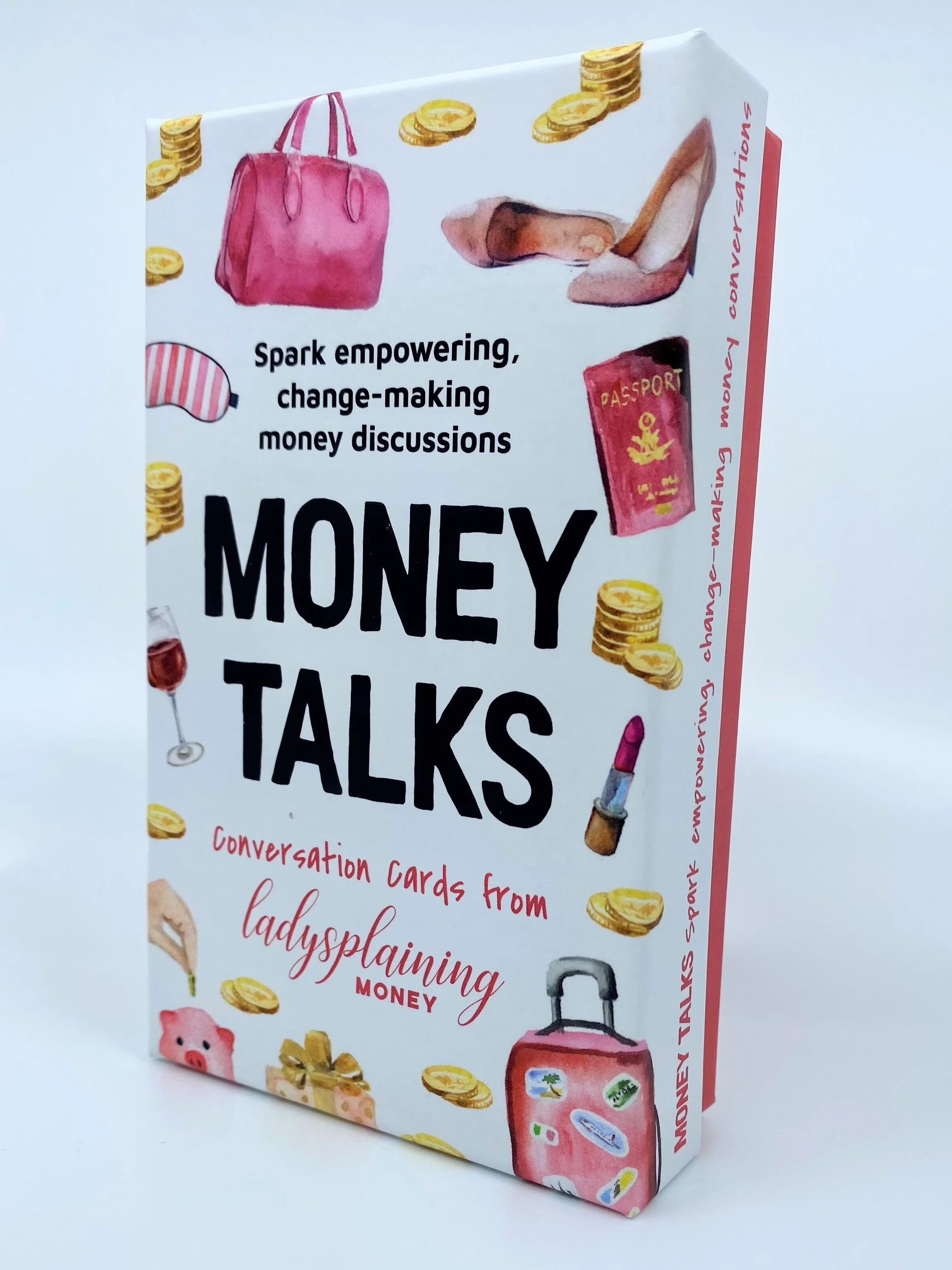
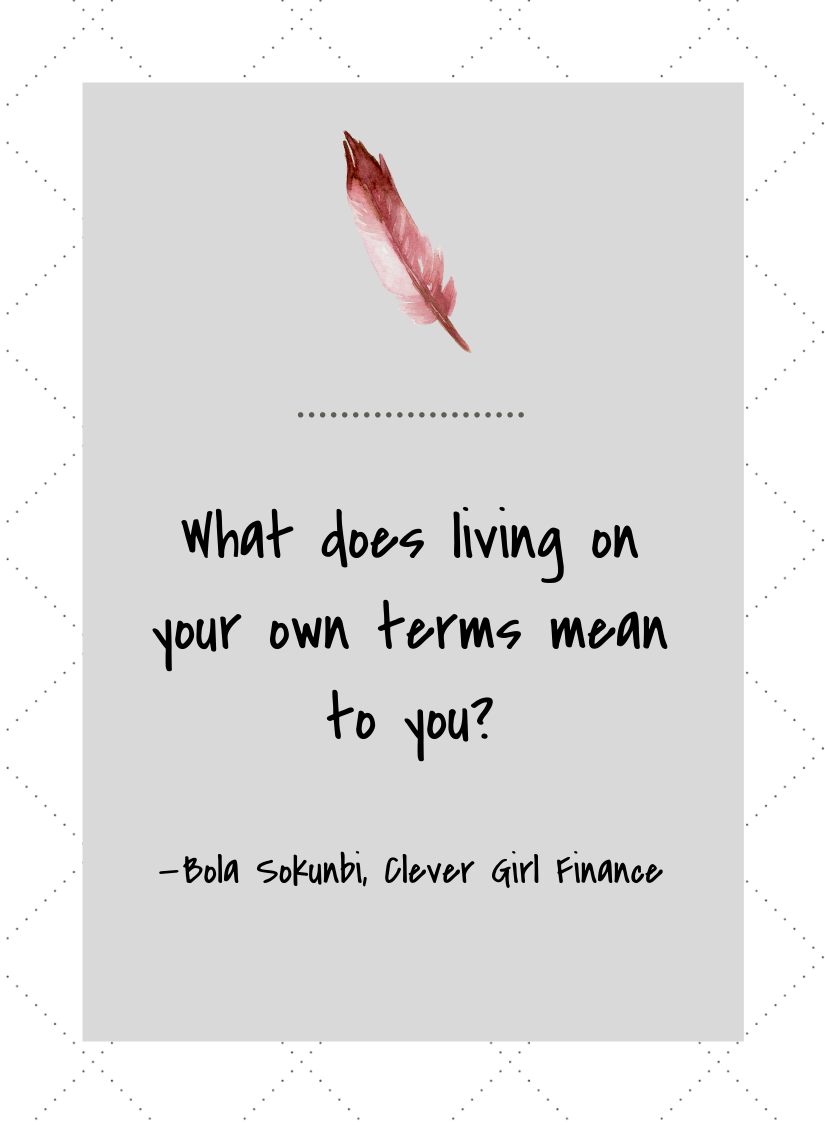
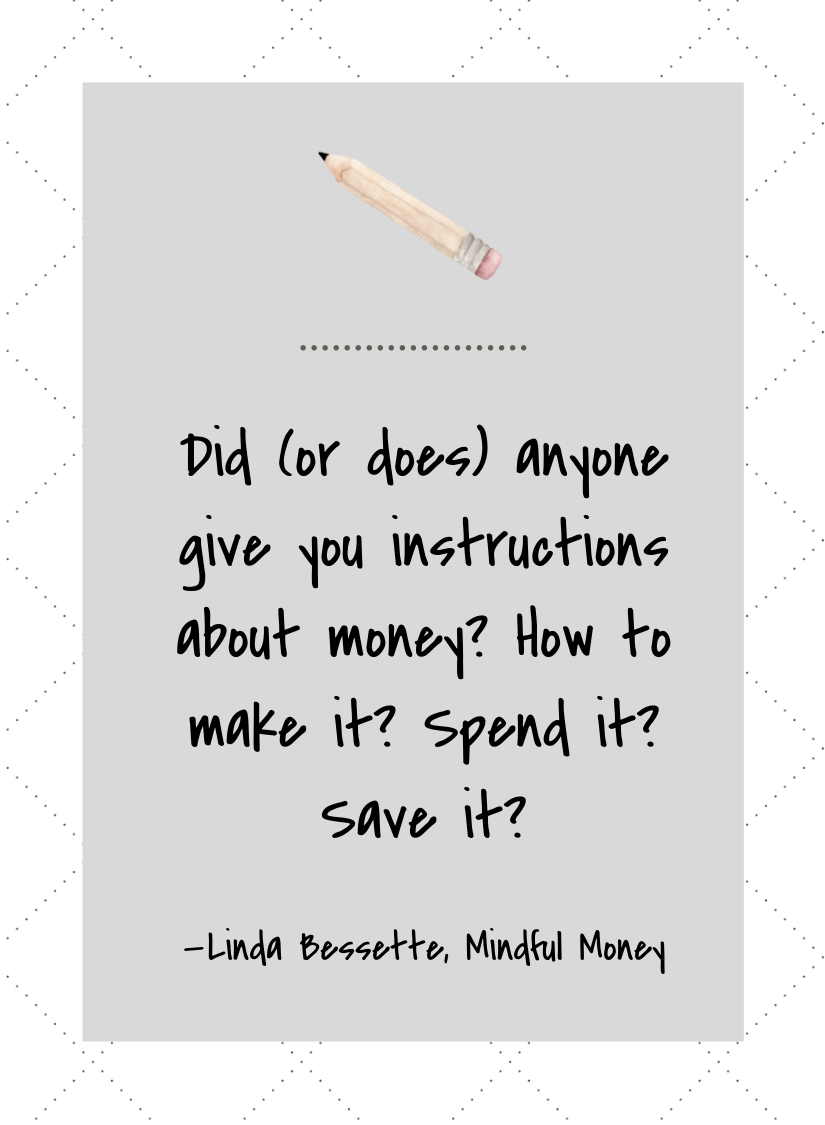
Part of building the pile of cash that will be your ticket to lifelong freedom is getting the conversation started. Perhaps you were raised to save money, but never given the tools for how. Or perhaps, you were raised never to talk about money at all. Whatever your situation, understanding your relationship with money and the lessons (good and bad) that have been passed down to you is key to breaking taboo. That’s why we created Money Talks: Conversation Cards from Ladysplaining Money.
About the cards, Sarah-Catherine Gutierrez (aka Ladysplaining Money) says: “What do you believe is the question that young women today must be asking themselves about money and talking about amongst their friends?
This is the question I asked women leading the finance industry today and whose opinions on money I deeply value. These cards are the result. Along with those you choose to play them with, you’ll delve into how you personally negotiate money in your relationships, career, and daily life as well as how you perceive money, dreams, and retirement.”
Ready to get the conversation started? Click here to order your cards with free shipping.

We Did It! Kickstarter Funded 129%
WE DID IT, together!
175 Kickstarter backers supported From Cotton to Silk: The Magic of Black Hair by Crystal C. Mercer and we finished in 30 days 129% funded with $9,528 pledged. We are SO grateful to everyone who helped us climb to the top.
Although we didn’t reach our full stretch goal, we got close enough that you can expect to see HAIR. SEEN. Heard. Conversations About Our Crowns cards.
THANK YOU! This outpouring of support has helped us dream big, and we are just getting started.
Happy Giving Tuesday! We're 66% Funded and We Need Your Help!
It's giving Tuesday! We love supporting Central Arkansas Library System, Celebrate Maya Project, The C.D. Wright Women Writers Conference, Women's Foundation of Arkansas, and other organizations promoting literacy for all and strengthening women (especially in their creativity).
Crystal C. Mercer's Kickstarter for her book From Cotton to Silk: The Magic of Black Hair is an incredible way to support a Black woman artisan in her craft--an entirely hand-stitched children's book representing 467 hours of sewing love. With 80 believers, it's 66% funded! But it's all or nothing and your support means everything. There are loads of handmade rewards at all levels to thank you for backing this project that is unique in all the world. Hope you'll spend a few minutes with "Auntie CC," to see a couple of book pages and learn more!
And whomever you choose to give to today, may you be awash in joy and appreciation for your gifts!

Join Et Alia on Our First Ever Kickstarter with Crystal C. Mercer!

Has this ever been done before? If so, we haven’t seen it! Every page of From Cotton to Silk: The Magic of Black Hair shares a bold, beautiful, masterful hand-stitched textile rendering that reflects dozens of hours of skill and love from the hands of Crystal C. Mercer.
The numbers speak: of the 3,716 books surveyed by the Cooperative Children’s Book Center (CCBC) in 2019, Black/African main characters made up only 12%. Don’t you agree that this just won’t do?
With your help, we can position this book as a beacon of self-worth for young Black girls!
Your Kickstarter support will:
Cover Crystal’s cost of textiles and sewing materials
Pay for textile photography by Arshia Khan
Cover book layout design by Dave McClinton at African American Design Group
Bring the retail price point from $21.95 to $19.95 to align it more closely with consumer expectations and make it more accessible to the girls who need its message most
Ensure that publishing costs are covered prior to publication so that we begin public sales with profitability
We are overjoyed to share this book and related rewards at all price points with you, including custom jackets and custom fabric portraits, as well as kente cloth bookmarks and kente totes—
all handmade by Crystal!
If we surpass our goal of $7,350, we’ve got some big surprises up our sleeves.
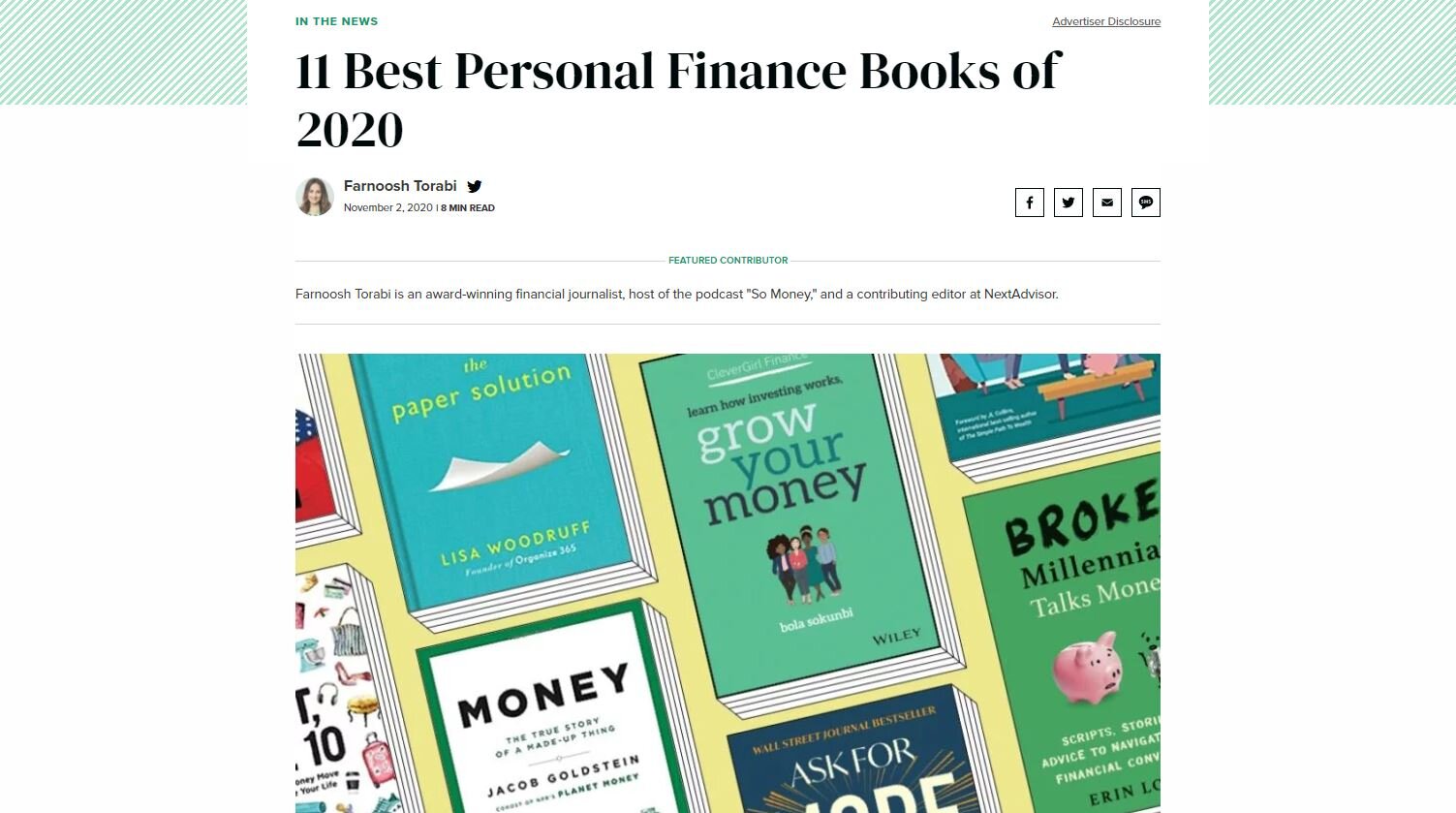
But First, Save 10 Named in Top 11 Personal Finance Books by TIME Next Advisor!
TIME’s Next Advisor released it’s list of top Personal Finance books of 2020, and, drumroll….
But First, Save 10 is Number 7!
The incredible Farnoosh Torabi of the “So Money” Podcast made the selection. To read the full list, Click Here.
Torabi says:
If there’s a single mantra that can be applied to everyone this year, it’s this: Save, save, and save some more. As the founder of financial planning firm Aptus Financial and the breadwinner in her family, Sarah Catherine Guitterez experienced firsthand the struggles many women can have with money, particularly when it comes to saving and investing. But First, Save 10, encourages saving at least 10% of every paycheck before doing anything else. It’s another way of saying “pay yourself first,” which is one bit of financial advice that Guitterez says she can’t preach enough.
“I realized we have got to demystify this … because women don’t engage with financial services in confident ways. There is a lot of avoidance when it comes to signing up for that retirement plan,” she told me. “My life’s career is going to be in being this translator. This person who can bring women to the table and actually say, ‘Hey, it’s not nearly as hard as it sounds. We make it hard, but it’s really not.’”
Congratulations for this well-deserved recognition, Ladysplaining Money, and for helping every reader learn the most important ways to empower herself!

Two Titles Selected Among 2020 Arkansas Gems by Arkansas Center for the Book
Et Alia titles have been selected among the 2020 Arkansas Gems by Arkansas Center for the Book at the Arkansas State Library!
Selected this year were:
Rooted: Central Arkansas Farm & Table by Lacey Thacker and Sara Mitchell
The Hospice Doctor’s Widow: A Journal by Jennifer A. O’Brien
This is the third consecutive year that Et Alia titles have been chosen. Last year, gems included Women Make Arkansas: Conversations with 50 Creatives by Erin Wood and What’s Inside: A Century of Women and Handbags, 1900-1999 by Anita Davis, the official book of ESSE Museum & Store. In 2019, Home Sweet Home: Arkansas Rescue Dogs & Their Stories by Grace Vest was selected.

Et Alia Press Writing and Editing Tips Series
Hello! Erin Wood, Et Alia owner/director here to let you know that I’m excited to share this series writing and editing tips.
Informed by more than a decade of small press publishing, nearly 15 years as a professional editor during which I’ve edited dozens of nonfiction and children’s books and hundreds of essays, years as a writing coach, and decades as a writer, these are tips I’ve seen help others and that have been valuable to me, personally, as a writer, editor, and publisher. I hope that they help you strengthen and deepen your writing and editing practice.

Ready for the cold, hard truth? No one is going to give you permission to create. Wait for someone to tell you it is okay to spend your time writing and making, and you may wait a lifetime.
Martha Graham (American modern dancer and choreographer who reshaped the teaching of dance) makes this offering for the why of not waiting for creative permission:
“There is a vitality, a life force, a quickening that is translated through you into action, and there is only one of you in all time, this expression is unique, and if you block it, it will never exist through any other medium; and be lost. The world will not have it. It is not your business to determine how good it is, not how it compares with other expression. It is your business to keep it yours clearly and directly, to keep the channel open. You do not even have to believe in yourself or your work. You have to keep open and aware directly to the urges that motivate you. Keep the channel open. No artist is pleased. There is no satisfaction whatever at any time. There is only a queer, divine dissatisfaction, a blessed unrest that keeps us marching . . .”
Those already familiar with this quote may note it is missing “keeps us marching, and makes us more alive than the others.” I struck it because I believe that in the right circumstances (which again, we must create for ourselves) we can and will ALL come alive in our creativity.

Writing is a practice. Like any practice (physical, mental, or both) the more it is done, the easier it is. Something like muscle memory, it can become a reaction, a habit.
Also, the more you write, the more you notice about the world around you that can then be turned into material for your writing, be it a topic, a beautiful phrase, or a beginning or ending sentence. So, writing begets writing. It's pretty magical.
To further your sense of accomplishment, at the beginning of each week, create a list of the number of times you plan to write or add “write” to your daily calendar. When you finish each session, cross through your task completed.
Before you know it, your practice will become easier. Sit down, and do it! Write on.
Guard your writing time like your life depends on it. The life of your mind does, and isn’t it true that the life of our bodies follows the life of our minds?
Set a standing appointment, a date with yourself, as you would set it with a friend or lover with whom you desperately want to spend time. Make it non-negotiable. During this time, allow your writing to captivate you completely. Turn your devices, your email, all the other roles that you play, OFF. Allow nothing to come between you and your writing. This writing time is yours and yours alone.
Many writers find that the early morning or late night offers the best opportunity to maintain these standing appointments because there’s a lower likelihood of interruption. In a 1993 interview in The Paris Review, Toni Morrison said, “Writing before dawn began as a necessity—I had small children when I first began to write and I needed to use the time before they said, Mama—and that was always around five in the morning.” Find the time at which you can best resist others’ needs of you. Remember, your writing needs you, too.

During your writing time, turn your devices, your email, all the other roles that you play (including as editor of your own work), OFF. Setting a timer during which your OFF time occurs can be one way to free your attention for the time period of your choice. Stay focused until those 20 minutes, hour and 20 minutes, or whatever your personal goal is, have passed.
In our connected, overstimulated, and currently news-saturated, doom-scrolling culture, this will require a very high level of vigilance. You can do it. You have to. Remember, the life of your mind, your wellbeing, depends on it. In the words of Martha Graham from an earlier post, “keep the channel open.” Your channel is what brings you closer to the divine, and it will not open if you do not turn off all other channels. Turn them off, turn your writer on.

Some of the most memorable writers in history only wrote a few hours daily (Toni Morrison) or set a relatively low word count goal (Earnest Hemmingway, 500 words per day or about the equivalent of two double-spaced pages). Release the mindset that in order to be a writer, you have to log full days, 7-days a week, or devote enormous stretches of time to your practice.
If writing daily isn't an option, try setting a weekly time or word count, and take pride in accomplishing your goal no matter how you divvied your time to reach the goal. Give it what fits into your schedule, keep your commitment to yourself/your date with your writing, and focus relentlessly during the time you commit. Everything else will fall into place.

What creates the best opportunity for you to enter that blessed, blissful flow state?
Is it writing by hand with a Dixon Ticonderoga No.2 or your beloved late grandmother’s ink pen? Is it moving everything off your desk and digging in on your PC or hitting a coffee shop (in your mask), popping open your laptop, and drowning out the noise with your headphones while listening to Bjork? Is it wearing your lucky socks? It looks different for everyone. You can't underestimate how finding the right setting might affect how much writing you get done.
What puts you in the mood to write and/or to let your creativity flow?

No matter how tempting, do not edit yourself in the early stages of planning and writing drafts. Realize that writing and editing are two very distinct processes. If it helps you to physically put an “editor hat” on your head, and physically remove it to emphasize this point for yourself, do so.
Early drafts are about ideas, production, freedom, and uninterrupted flow. They are not the time to stifle or question yourself. No matter how odd, nonsensical, or out of place something may seem at this stage, there is a reason it is coming to you. Your seemingly bizarre thought may become useful later for a purpose you can’t imagine now, so don’t take the red pen to it yet. Your intuition may be at work on something pretty cool.
There's no harm in considering the different directions a piece can take before you choose one. In fact, there’s only possibility. Just leave the possibilities there and keep writing.

Our brains are so neat. They process and make connections while we’re doing other things like taking showers, obeying stop lights, rocking our babies, stirring our stews. This time, during which you may otherwise feel you are doing “nothing important” in terms of your writing process, is actually a vital part of the process. Give yourself credit for this essential thinking!
Important stuff also happens when we are sleeping. Pro tip: before you go to sleep, read (don’t edit) a piece of writing you’re working on. When you wake up in the morning, you may find that some magical connections have been made while you were catching Zzzzs. Bump it up a notch by getting in the habit of writing “morning pages,” a journal of thoughts on waking. (Yep, do this before you ever look at your phone.) Julia Cameron introduced morning pages as a breakthrough writers’ tool in her book, The Artist’s Way, if you want to learn more.

Before you transition into the editing process, give what you’ve written room to breathe.
Breathing takes time and space. Time, as in hours or days or weeks passing, depending on the stage of writing you’re in, and space as in physical space (like, set it down and leave room that the writing is in and don’t look at it even though it calls to you to look at it).
When we are too close to our writing, we will have a harder time editing it. Also, it will feel harder to truly listen to others’ input, which could be invaluable. You may find that you react differently to criticisms and feedback of your writing if you allow room to breathe. It can be difficult not to be defensive of a piece when you've just written it and it's too fresh for the editing or revision stage.
So join the chorus, “Let it breathe.”

Especially when you are a less experienced writer (but even if you're seasoned), poorly thought out, uninformed, unconstructive, or even downright rude feedback can be devastating. And that is no exaggeration—writers have sadly put down their pens because of something someone else says. Don’t let this be you. Your writing is too important.
As you develop, think carefully about who you choose to share with (whether the reader is a writer, a friend, a writing group member, a mentor, an editor, etc.). You may not yet be ready to share your work with close friends and family, whether because of the subject matter or because you’re not ready for their reactions (positive or negative). You may find it more useful to be workshopped by peers or strangers who don't project interpretations of the text or insert facts based on details they know from from our personal lives beyond the page, which may not be in the creative work at all. Carefully consider the advantages and drawbacks of your relationship with each reader and how that might influence their feedback before you share, just so you are aware of it going in.
Always know that the reader’s opinion is just that, one opinion from one reader, with which you may or may not agree. Also always know that the aesthetics of writing are highly subjective. We all have style preferences, just like if we were to walk into a museum, we’d probably connect to a different piece of art than would the ten people around us. Remember that you’re trying to develop your own style and that your way of experiencing and expressing that experience is unique in all the world. Is your reader trying to make your style like theirs? Or are they helping you hone it to be more like your own?
The more you write and are edited and workshopped, the more you can fit advice into its proper category.

Previously, we looked at the importance of carefully considering who we share with. Now, why are we sharing? There is no wrong answer, and the answer may look different with every piece and change over time. But, if writing is part of your voyage of self-discovery, you’d be remiss to not answer the why, even if it is only to and for yourself . . .
Your inquiry might look something like this: Do I want to see if what I think I’m communicating lands with my readers in the way I mean it to? Does my ego need praise? Do I need the approval of others to feel that a project is valuable? Do I want to publish my work? Where do I want to publish my work? Why there? Is my desire for sharing and publishing my work altering the way I'm writing? If I’m altering my work for a publication, why, and do I feel comfortable with that? Do I want to improve as a writer? Maybe some of all the above?
Of course, it’s only natural to want people to like our work. Aren’t we, afterall, trying to gain an audience of readers who will actually spend their time reading what we spend all our time writing? Try to create your own perfect stew of revising with an eye toward the constructive feedback of trusted readers, humbly and open-heartedly accepting critiques that will help you improve as a writer, and staying true to your own style, always aware of your own, highly informative inquiry around WHY.

Related to the previous tip of wisely choosing a trusted reader or readers, and putting their opinions of your work into context, the timing of sharing is also important.
Have you ever shared an early or incomplete draft, or even just shared what this exciting new piece of writing is that you’re working on, and experienced the deflation effect? Like the wind just drops out of the sails and the sails end up adrift at sea and you never find the energy to pick the piece back up again? Consider whether you shared too early and think about keeping it longer in its sacred bubble where you can incubate it. That’s a lot of metaphor for one paragraph, and mixed metaphors at that, but maybe you get the idea: don’t share too soon. It can spell the end of your project.

Writing groups can be really awesome.
First, they can offer savings. Hiring an editor can be expensive. When you’re part of a writing group, you can get feedback from numerous writers while bartering your own time and feedback in exchange rather than paying for the service.
Second, they can provide many perspectives that will be helpful to your manuscript development as well as your development as a writer.
Third, they can offer much-needed accountability to make sure you remain committed to your practice (for writing and submissions).
Fourth, they can be your supporters in times of disappointment and cheerleaders in times of triumph.
As you learned in yesterday’s tip, writing groups can be awesome. Writing groups can also be not so awesome, and they are not all created with equal expertise or value. Ideally, you are growing as a writer and person throughout your time with a particular writing group. Dynamics may shift and members may come and go or no longer be able to contribute at the same level they once were. One member or the group may stifle your creativity. Or, you may need more advice particular to your genre. Whatever it may be, be honest with yourself about whether the group is working for you. If not, move on! There’s a writing group out there with a group dynamic that can help you thrive. If you can’t find one, form one from those you want to compose the group.
Need advice for best practices for running your writing group to maximize benefits for all involved?
For $5, you’ll receive a meeting structure and suggestions based on Et Alia owner/director Erin Wood’s more than 15 years of working with numerous writing groups. Message us for info.

Great life-skill in general, great skill with regard to writing feedback.
Although many writers prefer leaving things open-ended, it may be helpful to let your reader know what you're expecting from them. Not only can it be helpful to your writing, it can help you avoid unpleasant interpersonal situations.
Do you want feedback on the concepts in general? The framework? The chronology? The grammar? Stylistic choices? A particular passage you’re struggling with? Be honest with yourself and your reader about the type of feedback you want or find helpful, and consider choosing your reader based on a mix of your needs and their strengths. Readers will notice different qualities about your work and have differing interpretations of the same piece.

Tune up that good, old-fashioned, free voice you have and belt it out. Listen to it and revealed to you will be stumbles and mistakes that you didn’t notice on the page.
Reading out loud is a great way to discover if your writing has the tone you want it to. Does it sound stuffy and academic? Is it casual and conversational? Are your sentences too long to say in one breath? Another tip is to have someone else read your work back to you. Do they emphasize the words you had wanted them to? Does the pacing feel right? Use punctuation to guide your reader the way you want your content to be read. Use all the commas, sentence breaks, and new paragraphs you need to make your work sound the same out loud as it did in your head when you were writing it.

Too many long sentences in a row can overwhelm the reader, especially if the material or concept is complicated. Give your dear reader a brain break by varying sentence length and making sure every third or fourth sentence is brief, jargon-free, and easy to understand.

For book-length projects and for consistency across your writing, create a style sheet. This is a quick-glance one sheet that has all the grammar that you would otherwise keep looking up or flipping back to again and again.
You'll find this to be extremely beneficial and time-friendly within your writing process, and the consistency of a style sheet will make your writing more professional and credible.
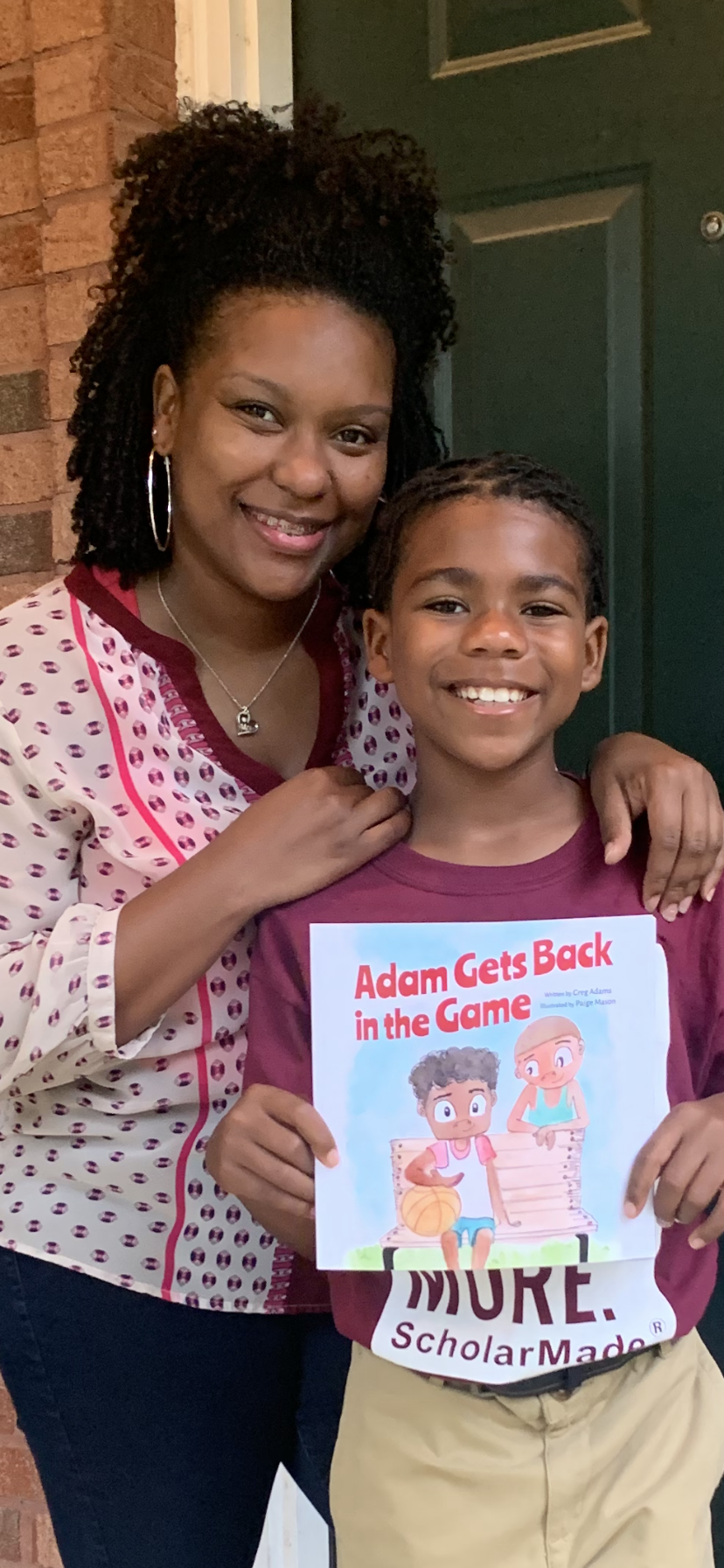
Adam Gets Back in the Game Helps Families Cope with Grief
Habitat for Humanity's central Arkansas chapter chose to include Adam Gets Back in the Game, written by Greg Adams and illustrated by Paige Mason, in its collection for Habitat families to use.
A mother read the book to her kids whose father had died. She sent this photograph and her email comments are shared with permission:
"We read the book as a family last night. I could see the change in his emotions when he read the part about Adam's friend dying. After we finished the book he was able to identify with the book in certain areas and even brought up his dad as well. We will read it a few more time then place it in the library box just in case it can be helpful to another family in Porter Cove. Thank you again for the book."
Know a family coping with loss that could be helped by this book? Find it here.
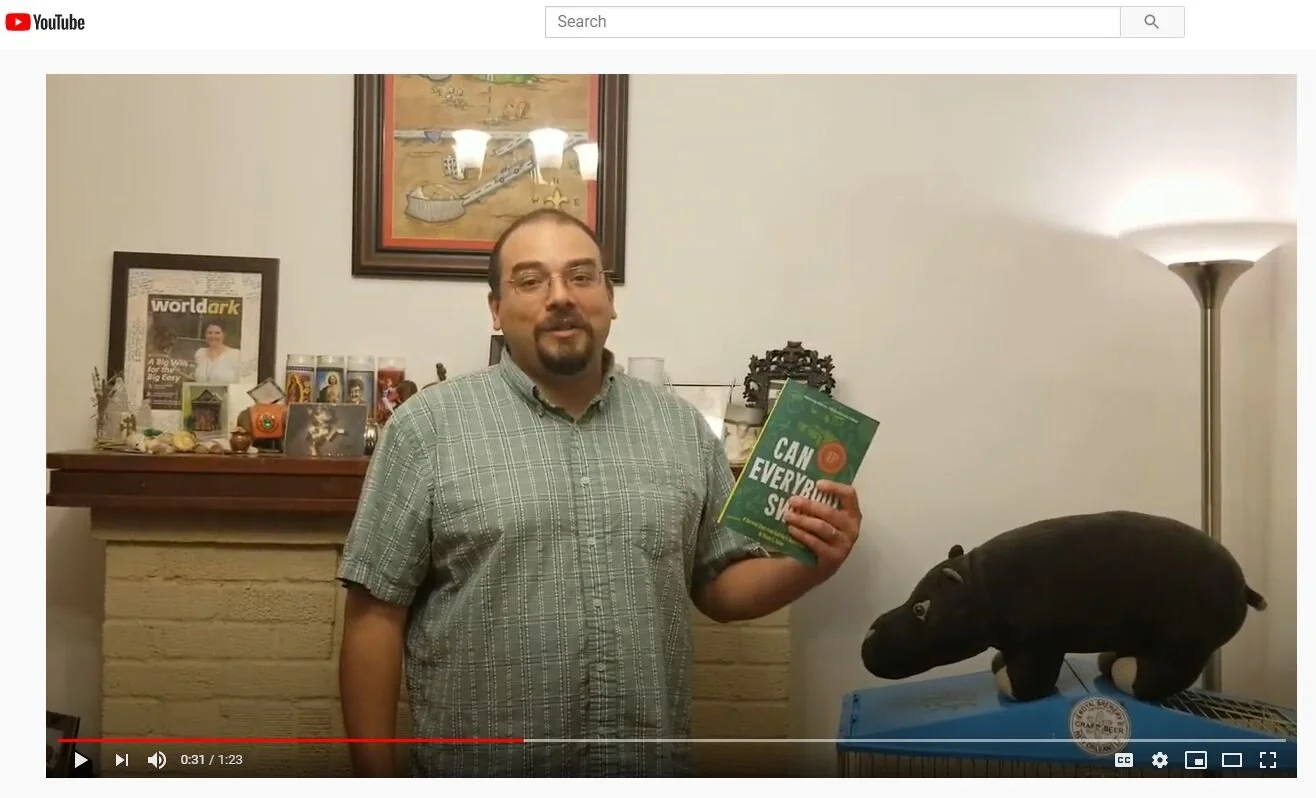
Bruce S. Snow introduces the Hurricane Katrina 15th Anniversary Edition of Can Everybody Swim? A Survival Story from Katrina’s Superdome
Can Everybody Swim Author Bruce S Snow Live from New Orleans
Live from the New Orleans Gentilly Neighborhood home from which he and his family of “four and a half” swam 15 years ago, Bruce S. Snow introduces the Hurricane Katrina 15th Anniversary Edition of Can Everybody Swim? A Survival Story from Katrina’s Superdome.
Book Excerpt from Chapter 2
Katrina: Her Sound and Her Fury
The four of us sat around the kitchen table sipping coffee and praying for a good outcome. The next couple of hours would make or break our little family. My mother, uncle, and I were calm for the most part, but Dolja and Jimena were beginning to show real signs of the strain. Normally, Dolja would run and hide at the first sound of thunder. He was lying on a couch pillow, keeping his fears to himself.
Jimena, on the other hand, had begun to show signs of a growing hysteria. She’d never experienced anything like this before. The empty streets, the howling winds, and the near-complete blackout of the sun. The candles in the center of the table gave off a macabre, shifting light that made our faces look waxen and dead. The fact that the three of us appeared so calm, I’m sure, added to her anxiety. Silent tears marched down her cheeks, and she began to chain smoke, as Mother and I were doing, subconsciously.
The scene was far too real for me. My Walkman radio could barely be heard above the furious gale. The time had come for the full strength of Katrina’s might. I excused myself to run back into my apartment, ten feet from the house, for a moment so I could brush the beer and nicotine from my teeth, and grab a couple more beers for what was about to come. My declaration was met with a volley of protest from my three companions.
“No, don’t go! We’ve got to stay together!” they said.
Finally, I negotiated three minutes to go next door while Mother waited for me, standing at the back door of the main house. I returned in the allotted time, clinking two beers in my hand. I would have never guessed that it would be the last time I’d see my apartment as it was, as I still see it in my dreams. I also wouldn’t have guessed that those three minutes were to be the last time I’d use running water or flush a toilet for a solid week. Once back in the main house, I threw one beer in the freezer—though the power was off, it was still cold in there—and opened the other.
My mother held the dog; Jimena, the flashlight. Uncle G held Jimena. We were forced to shout at one another to be heard. I grabbed the radio, the hippo, and a pillow to sit on. And the four and a half of us made for the hallway that separates the dining room from the bathroom and two of the bedrooms. We made ourselves as comfortable as we could in the narrow hallway and waited for the worst to pass. The noise intensified. I tried listening to the radio, but all I could hear was garbled voices. The small headphone speakers were terribly underpowered and could only be enjoyed in a close m; they couldn’t compete with the lashing rains and powerful gusts.
Through the windows, not much was visible. The sky was darker than I’d ever seen at nine in the morning. More like a clear night with a half-moon floating above. Not pitch black, but certainly not a summer morning in late August. The wind beat the sides of our home with such terrible fury that it was able to penetrate every microscopic point of entry. This created a sound akin to the wailing of ghosts in a bad horror movie. It felt like every bad thing I’d ever done in my life had found me and was seeping through the cracks to take me away with it. These ghoulish cries drove Jimena to more tears and started Dolja to shaking. Mother stroked his head and held him close, mumbling prayers to keep the spirits at bay.
The twilight darkness created by the thick, black clouds made the hallway a gloomy, depressing place. For sake of circulation, we’d opened the doors to the adjacent rooms, and the natural light from the exterior windows allowed a dim and diffused light to enter our tiny safe room. That is, of course, excepting those heartbeat milliseconds when the entire house would illuminate like one of my Abuelita’s New Year’s Eve gatherings.
It’s difficult to try to turn words on a page into the most brilliant flashes of lightning that may have ever hit planet Earth. Our house popped with dazzling white light, like a gigantic disco strobe with the hiccups. It’s even harder to turn words into sound. Glorious and ominous, like jet planes taking off all around you. The thunder reverberated through every nail, every floor board, every vital organ and toenail. BOOM! The sound waves hit our home continuously, not like a rumble of thunder, but like a shotgun going off in every room of the house at once. Big Sonic BOOMS washed over us from all directions at once. I could feel the thunder hitting me in the chest.
At some point in my life, I heard that when lightning strikes, if you slowly count the seconds until you hear the thunder, you can calculate about how many miles away the lightning flash occurred, or something to that effect. The equation may not be scientifically “perfect,” but light travels faster than sound, and all that jazz. This practice works just fine for an afternoon thunderstorm, sitting on a friend’s porch passing a blunt, but this is Katrina. Just forget all that shit. The magnificent flashes and the nerve-shattering claps occurred simultaneously, like the muzzle flash and report of the heavens’ own artillery exploding in the very hallway in which we sat. The thunder shook the house. No, seriously. Shook the house. As an earthquake must still shake a proper, modern earthquake-proof building, I imagine the ground tremors must still vibrate the structure, but it’s made for this, so it won’t fall apart. It’s no earthquake in New Orleans, just tremendous thunder claps. And we were not in a modern earthquake-proof building. We were in a sixty-plus-year-old termite-eaten Gentilly residence, set on a stack of cinder blocks. The sound waves created by the lightning strikes all around pounded the earth beneath. The ground around us relayed this force up through the foundation pilings, the cinder blocks, and through the entire wooden frame of 4899 Mandeville Street. I could feel the shotgun crack of thunder as it passed through the very grain striations of the wooden beams overhead and underneath. BOOM. All at once. The flash and the crash. BOOM. Add to this the constant, almost sublime, rumble of all the distant thunder. The 16 Can Everybody Swim? average thunderstorm count one-two-three-BOOM type thunder, the sustained 100-plus-mile-per-hour winds, the wailing fucking ghosts, and the crazy sheets—hell, blankets—of rain pounding our home. We endured the barrage at maximum intensity there in the hallway for close to three hours.
After an eternity, Uncle G dared, “It’s letting up . . .” We all strained our ears. He was right. The rain torrents had slackened to slapping sheets of a heavy downpour, much more like a thunderstorm common to sub-tropical New Orleans in the summertime. It took us some time to appreciate this change, for the wind continued to gust with unabated power. We’d been in the cramped hallway for hours when we decided that the worst must have passed and stood up on our sore legs. We wandered from window to window to survey the damage. Much to our surprise, the world was still there. A couple of downed trees and street signs, the awning over our front porch had detached and landed atop Uncle G’s van, but it hadn’t busted the windshield. The van had already looked beaten to death. No one would notice a few more scratches.
My little green truck parked next to the van appeared to be in perfect health. We made our way to the backyard patio for a much-needed cigarette. The wind still came in strong gusts, and driving rain fell from above, but the intensity had diminished from a 10, like what we experienced in the hallway, to about a 5 on the terror scale. The sky had lightened and the outdoors had gained the appearance of something resembling daytime.
“G, look!” I shouted
A section of the corrugated aluminum roof covering the garage had come loose and was flapping in the wind. Just a corner of the section over the little window, totally reachable from the ground. The garage at our house had long ago been converted from a place to store cars to a place for my grandparents to hang out. Amenities included couches, chairs, a decades-old stereo, even a wet bar. Within the prior six months, Jimena and Uncle G had bought them a flat screen television for the garage, so they could watch their novellas and baseball games on a 50-inch LCD.
The space was decorated with dozens of vintage bar lights my grandfather had collected. Some of the brands advertised on these electric signs had been out of business for well over thirty years. They were all functioning, all lit up, and some would even spin or had other moving parts inside. They were beautiful, they all worked, and they were all plugged into some kind of electrical outlet. Add to this Abuelita’s sewing machines and equipment, as well as the laundry appliances, and you can appreciate why the loss of a section of this roof would have been catastrophic. Falling rain and electronic appliances simply don’t mix.
“G, we’ve gotta do something,” I said.
“No!” Jimena shouted. “Don’t go out there. What if it falls on top of you?”
I stepped in and asserted control of the situation. “What if? What if we sit here and watch the roof blow off the garage, knowing we could have stopped it, M onday 17 Jimmy? This is why we didn’t evacuate. To protect the house. C’mon G.”
G hugged his wife and calmed her. I grabbed an oily work towel from the patio and a milk crate to stand on and dashed into the rain. The slightly rusted flapping corner of the roof required more than one attempt to catch, but once I got a grip on it, I held it down with all the strength in my two hands. The wind desperately wanted it back. Uncle G had run to Papi’s toolshed around the side of the garage and came speeding toward me carrying an enormous C-clamp, a kind of mobile table vise for wood cutting. We both stood on the milk crate, me holding the flap, G tightening the clamp.
“It’s good,” he shouted at me. And together we ran back under the cover of the patio roof, thoroughly soaked.
“We did it, Bruce!” “Hell the F yeah!” I shouted.
The wind still created ripples along that section of roofing, but the clamp was holding. We’d saved the garage. Morale soared over our accomplishment. There were hugs and high-fives all around. Time for another cup of coffee and some dry clothes. Katrina had thrown her best at us and we’d bested her. We’d saved the garage. Everything else would be fine. Everything was going to be okay. These prideful delusions would prove to be very short-lived.
Buoyed by this tactical victory, Uncle G and I decided to take a quick walk on the other side of the fence, out into the abandoned ghost town, for a reconnaissance. Why not? We were already wet. The rain had slackened into a light summer shower. The gentleness of the precipitation was disguised by darkened skies and the wind, which had lost very little of its brutal strength. We stepped out from under the protection of the patio overhang, through the six-foot privacy fence, and out into the naked light of the cloud-covered day. Things didn’t appear to be so bad. The storm drains were doing their jobs, no water had collected in the streets. Several small trees were down, some in yards, some in the streets, but all the large trees in sight had stood firm. I could see that our neighbor’s shed, up a block and across Mirabeau, had collapsed in on itself. Some of the wreckage had blown into the street to intermingle with the trees and other debris scattered across the neighborhood. We walked maybe halfway down our block on Mandeville to check out the homes of friends. The story was the same: some small trees down, plenty of yard debris, nothing catastrophic. Nothing that a couple rakes, maybe a saw, and some elbow grease couldn’t repair. There were no signs of life out there. No other curious people snooping around, no dogs barking, and no squirrels. Just Uncle G and me in this ominous, gray-skied I am Legend scenario. The feeling of being in a movie of some kind or a fantastic alternate reality was never too far from my thoughts. Every bit of life had been removed from a vibrant and thriving neighborhood. That’s not to say that things were quiet or still, not in the least. The gale-force winds assured there would be no true silence on the deserted streets.
We started on our way home, back the way we’d come. As we approached the corner, something stopped Uncle G where he stood.
A manhole cover in the middle of the street was releasing small gulps of water up into the street. Pumping one brown mouthful at a time up through the pry bar hole, like some kind of filthy aorta. We watched as the large, flat manhole lid filled and the water poured over the rim onto the wet street. On our walk, the rain completely stopped falling. No rain would fall on my head for the next week.
Another manhole across the street also went under. The storm drains on the curbs were steadily submerging. All of these puddles quickly united into one flat sheet of water from one curb to the other, creeping up the grass line to the sidewalk where we stood. This process couldn’t have taken more than five or ten minutes.
“I wonder what’s wrong with the pumps,” I said.
“Yeah, that’s no good. It’s the drain, right Bruce? Should be sucking the water up, not pushing it out into the street.”
“Word. They’ll figure it out. Let’s go back inside. I need a nap.” The beers were really starting to weigh on me.
“Sad. Set me up with the radio, Bruce Juan.”
Once inside, I grabbed Klaus the hippo, stretched out on the loveseat in the living room, closed my eyes and nodded off. The rising water had swallowed the sidewalks, and the wind continued to send the occasional ghost spinning through our home, but I was exhausted. Sleep came quickly for once.
Chapter 3
When the Levee Breaks
We had no way of knowing that less than a mile away the London Avenue Canal had broken its levee, almost in a straight line from our front door. The levee broke just north of the point where Mirabeau Avenue crosses the London Avenue Canal, flooding neighborhoods on the east side of the waterway. Our side of the waterway. The image of a furious tidal wave may come to mind, and for the homes right against the canal walls this certainly must have been the case. Over a month later, I would see one of these houses washed from its foundation and pushed more than thirty feet into the middle of Warrington Avenue. . . .
…Continue reading by ordering your copy of Can Everybody Swim?
